After the Peak, a Pause
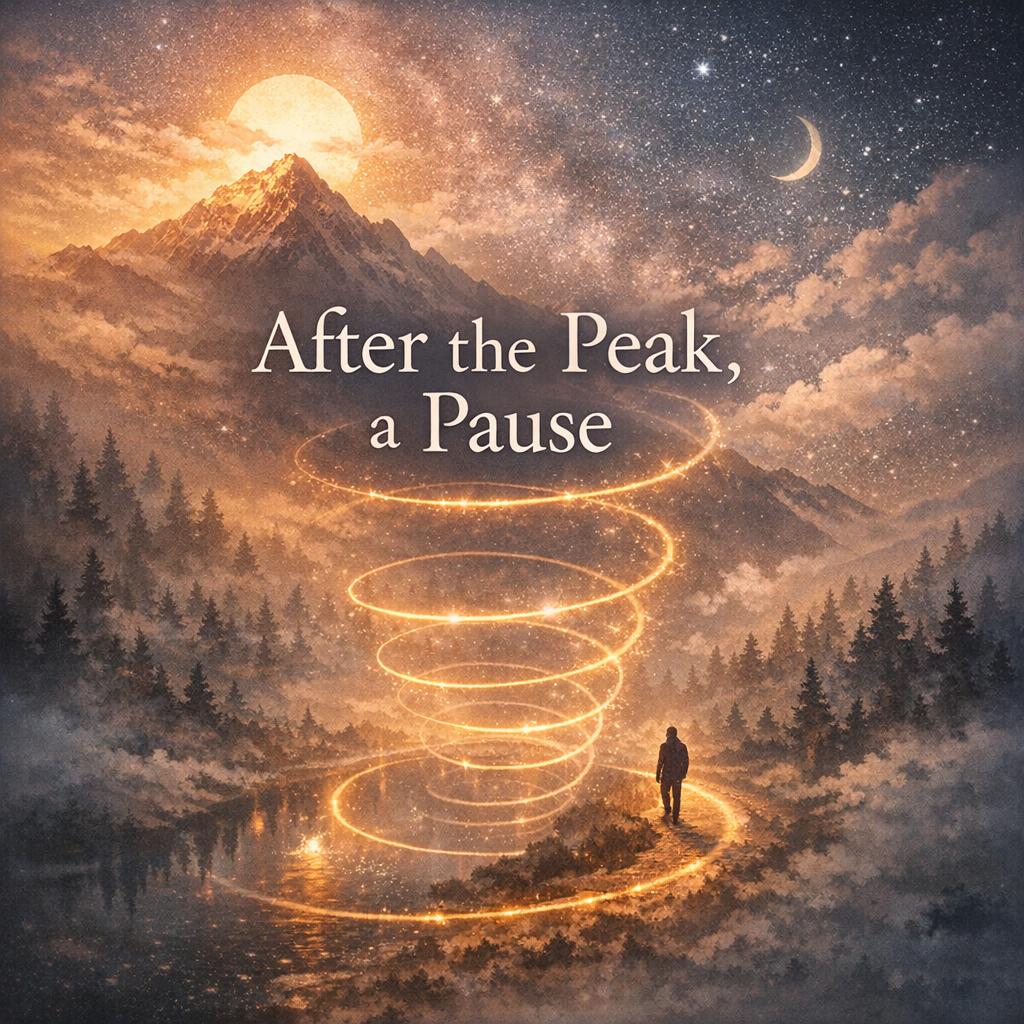
After the Peak, a Pause
Contraction after expansion is not regression. It’s integration.
There’s a quiet expectation most of us carry about growth.
We assume that once we see something clearly, we’ll keep seeing from that clarity. Once we expand, we’ll stay expanded. Once a breakthrough lands — insight, healing, direction, coherence — life will subtly upgrade around it.
But that hasn’t been my experience. And if I’m honest, it probably hasn’t been yours either.
After the peak comes a pause.
Not a dramatic crash. Not necessarily a crisis. Just… a flattening. A fog. A subtle loss of colour. Energy dips. The magic that felt so available a week ago becomes harder to reach. Conversations feel smaller. Motivation thins. The world feels heavier, more literal, more ordinary again.
And the reflex is almost always the same:
Have I lost it?
Was it real?
Why does it feel like I’ve gone backwards?
But what if nothing has gone wrong? What if contraction is not regression — but the body doing what bodies do?
Because growth is not a staircase. It’s not even a cycle in the sense of endlessly returning to the same place. It’s an oscillation — an expansion and contraction that, with attention, slowly migrates outward. A spiral rather than a circle.
Expansion increases amplitude. It stretches the system. But stretched systems carry load. Insight is not abstract; it’s physiological. Meaning reorganises the nervous system. Clarity demands recalibration.
And recalibration does not feel like transcendence.
It feels like pause.
I. The Oscillation Law
If you watch any living system long enough, you start to notice a rhythm.
Breath expands and contracts.
Muscle fibres tense and release.
The heart fills and empties.
Even attention itself widens and narrows throughout the day.
Nothing living moves in a straight line.
And yet, when it comes to personal growth, we expect linearity. We expect each insight to stack neatly on top of the last, forming a clean upward staircase. We expect momentum to be permanent.
But growth behaves more like a wave.
Expansion increases amplitude. It stretches your sense of identity, possibility, and coherence. You see further. You feel more connected. Meaning becomes vivid. There is velocity in it — a sense of forward motion that feels natural and almost frictionless.
But amplitude is metabolically expensive.
When you expand, you increase load on the system. Not just mentally, but physiologically. The nervous system has to recalibrate around new information. Old patterns lose relevance. Identity loosens its grip. The body, which always prefers coherence to speed, slows things down.
And that slowing is often misinterpreted as collapse.
The fog.
The irritability.
The sudden flatness.
The loss of intuitive “signal.”
It can feel like something has broken, but what’s actually happening is recalibration. Expansion pushes the system outward. Contraction pulls it inward to consolidate. Without contraction, expansion would fragment you. Without pause, velocity would destabilise.
The wave is not failure. The wave is the mechanism.
And when we resist the contraction phase — when we try to push for another peak before the system has reorganised — the oscillation becomes harsher. What could have been a gentle pause becomes exhaustion. What could have been integration becomes burnout.
This is not mystical. It is biological. The mistake isn’t expanding. The mistake is assuming we should remain expanded.
Growth is oscillatory. And when we begin to see that clearly, something subtle shifts: contraction stops feeling like betrayal.
It starts to feel like part of the design.
II. Hormesis & Load
There’s a concept in biology called hormesis.
It describes a simple but powerful principle: small, manageable stress strengthens a system. Too little stress leads to stagnation. Too much stress overwhelms and damages. But the right dose — applied, absorbed, recovered from — increases resilience.
Exercise works this way.
Cold exposure works this way.
Learning works this way.
Stress is not inherently harmful. It’s instructional. It tells the system how to adapt. But adaptation requires recovery. Without recovery, stress becomes strain. Without consolidation, growth becomes destabilisation.
Now consider this: insight is a form of stress.
A genuine breakthrough — psychological, relational, spiritual, creative — is not just an idea landing in the mind. It reorganises perception. It shifts identity. It challenges assumptions the nervous system has been using for years. It widens the aperture.
That widening is exhilarating. It is also demanding.
When you see something clearly that you hadn’t seen before, your internal architecture has to adjust around it. Old patterns don’t fit as comfortably. Old motivations lose their grip. Even your baseline emotional tone can change. And all of that requires integration at the level of the body.
If the insight is within your adaptive capacity, the system absorbs it, strengthens, and stabilises at a slightly higher baseline. If it exceeds that capacity — even temporarily — the system clamps down.
Fatigue increases.
Cognitive clarity drops.
Emotional tolerance narrows.
The world feels heavier, more literal, more material again.
This isn’t punishment. It isn’t evidence that the insight was false. It’s load management. The body always gets first refusal.
If expansion outruns integration, the nervous system will enforce a pause. Not because you failed — but because survival and coherence always take priority over momentum.
In that light, the “drop” after a peak starts to look different. It isn’t regression. It’s recalibration under load. It’s the system negotiating how much amplitude it can sustainably hold.
And here’s the subtle shift: once you understand that revelation carries load, the pause stops being mysterious.
It becomes necessary.
III. The Body Always Gets First Refusal
It’s tempting to treat growth as something that happens “up there” — in thought, in meaning, in insight. But the body is not an afterthought. It is the substrate.
And the body does not care how elegant your framework is. It cares about coherence. About safety. About energy allocation. So when expansion increases load, the body responds first.
Sleep shifts.
Energy fluctuates.
Emotional tolerance narrows.
Motivation thins.
Sensitivity increases.
The world can feel oddly flat — hyper-material, almost literal — as if the sense of subtlety has temporarily dimmed. Conversations feel smaller. Inspiration feels further away. Even joy can seem muted.
This is often the moment when doubt creeps in.
Was the clarity exaggerated?
Have I gone backwards?
Why does everything feel so ordinary again?
But ordinariness is not evidence of failure. It is evidence of consolidation.
The nervous system does not integrate at peak frequency. It integrates at rest. Just as muscle fibres repair during recovery, not during exertion, insight stabilises during contraction, not during expansion.
The body reduces velocity so that reorganisation can occur.
And this reduction can feel like loss — especially if you’ve grown accustomed to the heightened state of expansion. There is a kind of withdrawal from amplitude. A return to smaller bandwidth.
But smaller bandwidth is not smaller being. It is focused reassembly.
When we resist this — when we try to push for another breakthrough before the system has settled — fatigue deepens. Irritability sharpens. Fog thickens. What might have been a gentle recalibration becomes prolonged exhaustion.
But when we allow it — even reluctantly — something different happens. The contraction becomes cleaner. Not pleasant. Not glamorous. But cleaner. We stop fighting the wave. And in doing so, we conserve the very energy that will eventually carry us forward again.
Because the pause is not an ending. It is the part of the spiral where integration takes root.
IV. From Cycle to Spiral
If growth were only oscillation — expansion followed by contraction, peak followed by pause — it would feel circular. Repetitive. As though we were destined to revisit the same lessons endlessly, rising and falling without direction.
And sometimes, that’s exactly how it feels.
The same doubts return.
The same fatigue.
The same questioning.
It can seem as though nothing has changed. But there is a crucial distinction between a cycle and a spiral.
A cycle repeats unconsciously. A spiral revisits consciously.
In a simple cycle, contraction feels like failure every time. Expansion feels fragile. The system swings between states without understanding the pattern, interpreting each dip as loss and each rise as redemption.
But when attention enters the oscillation, something shifts. You begin to recognise the signs of contraction sooner. You stop catastrophising the pause. You understand that the flattening is not erasure, but consolidation. You fight it less. You recover faster. The amplitude may still fluctuate, but the integration becomes cleaner.
The lesson is not new. The vantage point is. That is spiral growth. You revisit similar terrain — doubt, fatigue, recalibration — but with more awareness. More preparedness. More trust in the mechanism. The same wave passes through you, but it does not destabilise you in the same way.
And gradually, almost imperceptibly, the baseline migrates outward. Not dramatically. Not in a permanent blaze of peak-state living. But in resilience. In tolerance. In the ability to hold slightly more amplitude without fragmentation.
The oscillation remains. But the centre expands. And that is where velocity begins to change.
V. Velocity Without Fragility
We often equate velocity with intensity — with staying at the peak, sustaining inspiration, maintaining constant expansion. But that kind of velocity is brittle. True velocity is not about how high you can rise. It is about how cleanly you can oscillate.
If contraction no longer terrifies you, recovery accelerates. If pause is not misinterpreted as collapse, energy is conserved. If recalibration is allowed to complete, the next expansion requires less force. Velocity stabilises. Not because you avoid the wave, but because you move with it.
Creative hunger returning before energy fully restores is often the first sign of this shift. Direction reappears before stamina. Curiosity flickers before strength returns. The system is not back at peak — but it is reorganising at a higher level. This is not the end of oscillation. It is a cleaner relationship to it. And that cleaner relationship is what slowly increases sustainable amplitude.
Not a staircase.
Not a loop.
A spiral.
Each peak followed by pause.
Each contraction followed by consolidation.
Each return carrying a slightly wider view.
After the peak comes a pause. Not ending. Integration.
VI. When You Find Yourself “Here Again”
There is a particular flavour of frustration that arrives in contraction. It sounds like this:
Why am I here again?
I’ve already done this.
I thought I’d moved past this.
The reflex is almost always resistance. A tightening. A subtle accusation toward yourself or the process. But the spiral does not return you unchanged. So the more useful question is not, “Why am I back here?” It is:
What is different about me this time?
When you notice yourself spinning — foggy, fatigued, irritable, flat — pause before the story forms. Before you decide this is regression.
First, ask something deceptively simple: Are you certain this is the exact same place? Or does it only resemble it? Then anchor. Name five things that are still true. Not aspirational truths. Not grand frameworks. Simple, stabilising realities.
- What do you know now that you didn’t know last time?
- What do you trust now that you once doubted?
- What no longer hooks you as deeply?
- Where does your North Star reside now?
- And what feels steadier beneath you, even if the weather hasn’t changed?
Often, you’ll find something subtle but important: the terrain looks similar, but your footing is steadier. The emotions still move, but they don’t define you as completely. The doubt still whispers, but it no longer convinces.
You are not the same person who first walked this stretch of path. Even if the weather feels familiar. This is the shift from unconscious cycling to conscious spiralling. You’re not being sent back. You’re being shown the same landscape from a slightly higher vantage.
And that vantage changes everything.
VII. Toward Velocity
Once oscillation becomes conscious, something else begins to shift. You stop trying to eliminate contraction. You start integrating it. And when contraction is integrated rather than resisted, recovery accelerates. Energy is conserved. The system reorganises more efficiently.
This is where velocity changes — not as intensity, but as coherence.
Velocity is not about staying expanded. It’s about how cleanly you move between states. How quickly you stabilise after load. How little friction you add during pause.
The spiral does not remove winter. But it teaches you how to winter well. And from that — slowly, almost invisibly — sustainable amplitude increases.
That is the arc we’ll begin to explore next. Not how to live at the peak. But how to increase velocity without fragmentation. How to expand without outrunning integration. How to move through oscillation with less fear and more awareness.
After the peak comes pause. Not ending. And if you’re here again — look closely.
You are not who you were.
AT Glossary — After the Peak, a Pause
Amplitude – The range of expansion a system can sustainably hold. In AT usage, amplitude refers to the increased cognitive, emotional, and perceptual capacity that follows growth — but which also increases systemic load. Greater amplitude is not permanent peak-state living, but the ability to stretch further without fragmentation.
Contraction – The inward phase that follows expansion. Not regression, but recalibration. Contraction consolidates new insight at the level of the nervous system and identity, stabilising what was previously only experienced at peak amplitude.
Oscillation – The natural expansion–contraction rhythm of living systems. In the AT framework, growth is oscillatory rather than linear; each expansion generates load, and each contraction integrates that load. When conscious, oscillation becomes spiral development.
Spiral – Conscious oscillation. Unlike a cycle, which repeats unconsciously, a spiral revisits similar terrain from a widened vantage point. The external landscape may appear familiar, but the internal footing is steadier and the baseline has migrated outward.
Velocity – Not intensity or perpetual expansion, but the efficiency with which a system moves between states without fragmentation. Increased velocity reflects cleaner oscillation, reduced friction during contraction, and faster recovery after load.
Resonant Intelligence: What Intelligence Become When It Stops Trying to Win