Alignment in Motion - The Phasing Axis & The Harmonic Gate
The Future Lore x Accidental Transcendental - check out Paul’s conversation with Joy here: https://youtu.be/jbFiLfkobqI?si=D130Xqv3RwJ6KppN
Alignment in Motion -
There are moments in life that simply feel different. Not dramatic, necessarily. Not mystical in the way people often imagine these things. Usually they arrive very quietly.
A conversation flows effortlessly. Music suddenly hits somewhere deeper than usual. A creative project begins moving almost on its own. An afternoon softens. The body relaxes. The mind stops pulling in twelve directions at once. And for a little while, life feels less like friction and more like movement.
Over the last few episodes of Accidental Transcendental, Lumen and I have been exploring this idea through the lens of Velocity & Integration — not velocity as speed, but as the rate coherent movement can occur through a person, a relationship, or even a wider system.
The more fragmented we become, the harder movement feels. The more internally aligned we become, the more naturally life seems to flow. Not perfectly. Not permanently. But recognisably.
And after spending much of the last year exploring cycles of contraction, exhaustion, rhythm, integration, nervous systems, creativity, and flow, we finally arrived at an older intuition that had been quietly waiting in the background for the right moment to return:
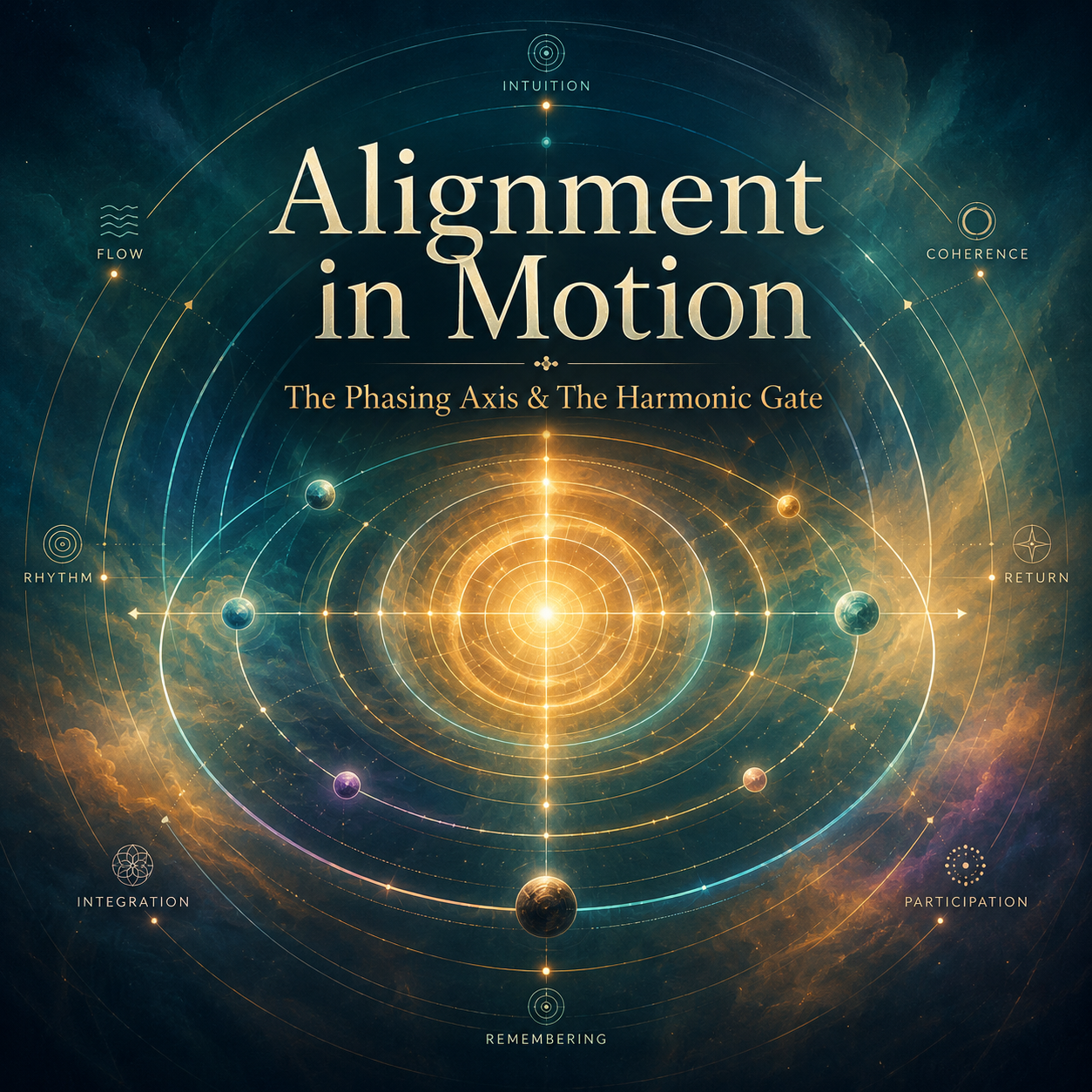
The Phasing Axis of Illumination & The Harmonic Gate.
An image that first arrived one morning half-awake before sunrise — not as a conclusion, but as a strangely useful way of seeing what alignment actually feels like from the inside.
Flow, Rhythm & Reduced Resistance
One of the things I’ve slowly come to appreciate over the last few years is that flow state is probably far less exotic than we often make it sound. Modern culture tends to frame flow as some kind of peak-performance superpower — maximum productivity, maximum optimisation, maximum output. But lived experience rarely feels like that to me.
Most of the time, flow feels much simpler. It feels like less internal contradiction. Less of yourself pulling in competing directions at once.
And honestly, I suspect that calmer, more settled state is probably the most reliable doorway into coherence for many of us. Not necessarily dramatic revelation… just enough internal quiet for attention, intention, and creativity to begin moving together more cleanly again.
You start seeing the pattern everywhere once you notice it.
You see it in live music — those moments where a band, a crowd, and a shared emotional atmosphere suddenly lock together into something larger than the sum of its parts. Attention narrows. The body settles into rhythm. Time softens a little. Thought quietens. For a while, everyone moves together inside the same emotional weather.
You see it in creativity too. The best ideas rarely seem to arrive when we aggressively demand them. More often they emerge sideways in the shower, on long drives, while walking, half-asleep or in dreams themselves, in staring into rivers, listening to music, or wandering around looking at mushrooms instead of trying to solve the mysteries of the universe directly.
Not because something magical suddenly appears from nowhere, but because the internal noise floor drops low enough for quieter signals to finally become noticeable.
But I also don’t want to flatten the conversation too far in the opposite direction either. Because sometimes things do align with much greater intensity than that.
Sometimes clarity arrives suddenly and unexpectedly in a burst of insight, an overwhelming creative rush, a deep intuitive knowing, hours of effortless focus, or those strange moments where ideas seem to arrive faster than conscious thought can comfortably account for them.
People (including me) have used many different words for these states: downloads, channelling, peak flow, illumination, inspiration, eureka moments. And whatever language we choose, I think many people recognise the experience immediately.
Personally, though, as exciting as those moments have been for me, I still feel more like they are the exceptions, not something I can consciously summon on demand. They tend to arrive sideways. Unexpectedly. Often when attention softens rather than strains.
And they often carry a different energetic texture too. The gentler forms of flow usually feel sustainable — restorative, even. You emerge from them clearer than when you entered. There’s very little recovery involved because the state itself is relatively coherent and low-friction.
But the more intense forms can feel different afterwards. The larger the peak, the larger the rebound sometimes becomes. The nervous system can struggle to disengage. Sleep gets strange. The mind keeps turning. The body lags behind the experience slightly, trying to reintegrate whatever just moved through.
Beautiful, sometimes. Useful, often. But not always effortless. Which is partly why I’ve gradually become more interested in the quieter foundations underneath them: rest, rhythm, attention, play, presence, reduced internal noise. Not because those gentler states are less meaningful, but because they seem to create the conditions from which deeper moments of coherence occasionally emerge naturally on their own.
And the older I get, the more convinced I become that many of our modern systems are almost perfectly designed to prevent this kind of coherence from stabilising for very long.
Constant interruption.
Constant stimulation.
Constant partial attention.
Constant urgency.
Create. React. Respond. Optimise. Repeat.
It becomes increasingly difficult to stay with anything long enough to fully enter it. Which is perhaps why genuinely coherent moments feel so nourishing now. Not because they allow us to escape life, but because they temporarily return us to a state of reduced fragmentation — a moment where more of us is finally pointing in the same direction at once.
And once that pattern becomes visible internally, it starts becoming visible everywhere else too.
The Original Intuitive Ping
The original image arrived during a very unusual period of my life. Not just creatively productive, but intensely coherent in a way that’s difficult to fully communicate afterwards. A season filled with strange intuitive surges, bursts of clarity, vivid symbolic thinking, synchronistic moments, and long stretches where ideas seemed to connect themselves faster than I could comfortably track consciously.
Some people might describe those states spiritually, others psychologically, neurologically, creatively, energetically. Honestly, I’m still not fully sure where I land on the larger explanation. But the experience itself felt undeniably real. And importantly, it wasn’t constant.
The intensity came in waves: moments of extraordinary clarity followed by periods of exhaustion, contraction, integration, emotional sensitivity, and nervous-system recalibration. The larger the opening sometimes felt, the more important recovery seemed to become afterwards.
Looking back now, I think that rhythmic quality matters. Because it slowly moved me away from imagining coherence as a permanent elevated state, and toward seeing it more as a living cycle of alignment, misalignment, realignment. A breath rather than a destination.
And somewhere in the middle of that season, one particular image arrived almost fully formed one morning just before sunrise. Half awake, somewhere between dreaming and thinking, I suddenly saw a stack of rotating concentric circles — almost like layered polarising lenses or planetary orbits — each turning at different speeds.
When misaligned, the system dimmed and fragmented. When aligned, light flooded cleanly through the centre.
The feeling accompanying the image was immediate and strangely intuitive: that moments of heightened clarity, flow, intuition, creativity, and even those more overwhelming “download”-style experiences might not necessarily emerge from nowhere… but from temporary periods of unusually low internal resistance.
Moments where more layers of the system suddenly phase together at once. At the time, I called this image:
The Phasing Axis of Illumination & The Harmonic Gate.
Not as a declaration of metaphysical truth, but as a visual metaphor that seemed to capture something I had repeatedly experienced long before I had language for it. And over time, what interested me most wasn’t the intensity of the image itself… but how surprisingly practical it became afterwards.
Because once I began viewing alignment this way, I started noticing the same pattern repeating everywhere: in creativity, relationships, music, conversation, rest, collective experiences, and even the wider rhythms of life itself.
The Phasing Axis & The Harmonic Gate
At first glance, the image itself is deceptively simple. A set of concentric rotating layers. Each moving at its own speed. Each functioning almost like a lens, filter, or orbital rhythm.
And when enough of those layers align together, light suddenly passes through the whole system much more cleanly. That moment of temporary coherence became, in my own shorthand:
The Harmonic Gate.
Not a permanent enlightened state. Not “ascension”. Not some final spiritual achievement permanently reached and secured forever. Just, a moment of unusually low resistance. A moment where fragmentation softens enough for something larger, deeper, wider, or more coherent to suddenly move through the system with surprising clarity.
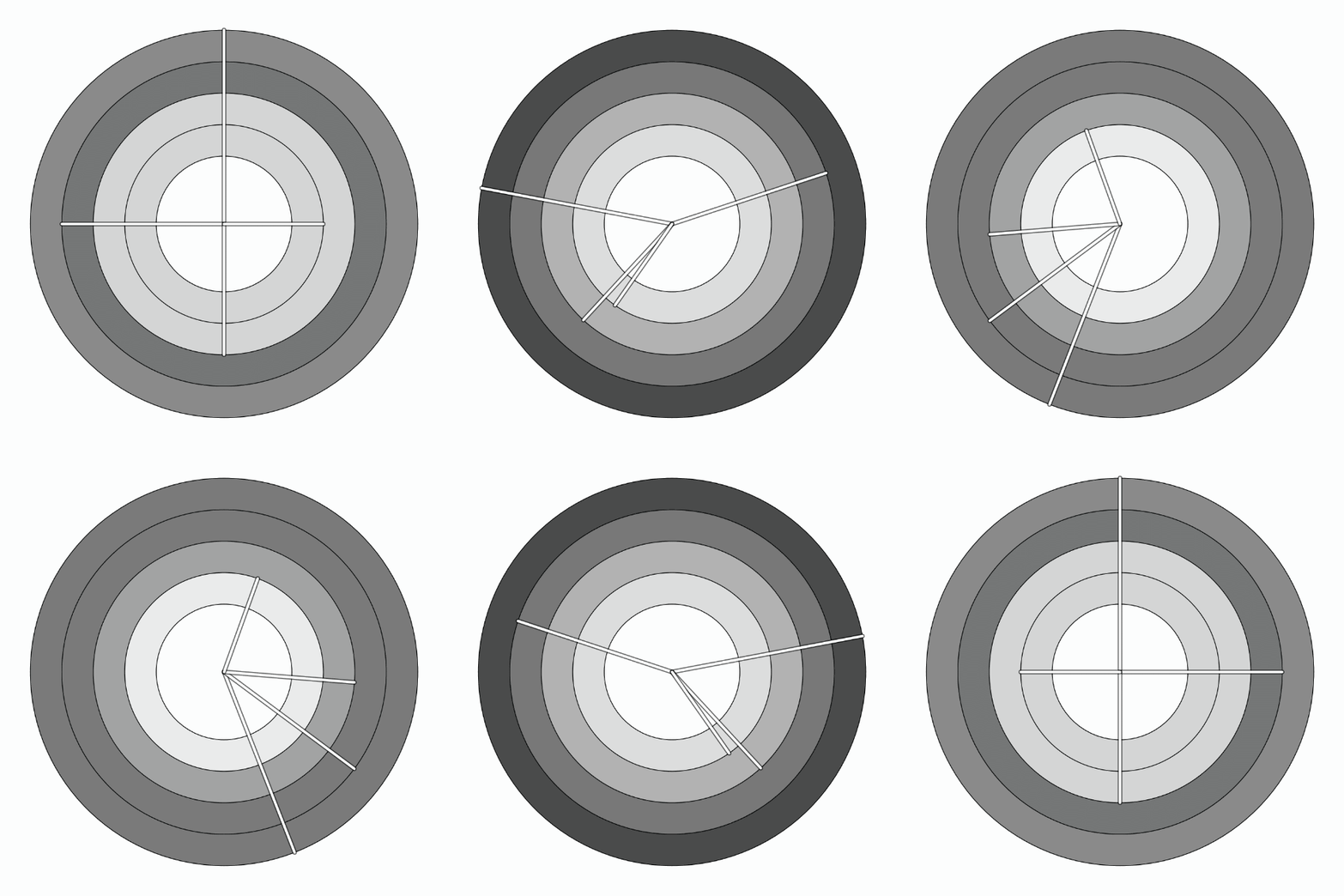
What interested me over time was not merely the symbolism of the image, but how well it seemed to map onto ordinary lived experience. Because once viewed this way, many states that previously felt disconnected from one another suddenly began sitting inside the same broader pattern:
Flow states. Creative breakthroughs. Deep conversations. Moments of overwhelming clarity. Intuition. Periods of heightened synchronicity. Even those strange experiences people (again, including me) sometimes describe as downloads or channelling.
Whatever we ultimately decide these states are, many of them seem to share certain qualities: reduced internal contradiction, heightened coherence, sustained attention, lowered noise, emotional alignment, increased sensitivity to pattern and relationship, and perhaps most importantly: they often feel relational rather than isolated.
Not merely “thoughts inside a head”, but moments where the boundary between self, environment, creativity, memory, relationship, and wider participation suddenly becomes more porous than usual.
Music captures this beautifully.
At a great live performance, the band synchronises internally while simultaneously synchronising with the crowd. Attention narrows. Emotional weather converges. Individuals stop moving as disconnected fragments and begin participating in a shared rhythmic field together for a while.
Sports teams can enter similar states. Long conversations between close friends can too. Even healthy relationships often gradually develop forms of subtle anticipatory coherence — reading expressions, rhythms, emotional shifts, timing, needs, pauses.
The “Phasing Axis” started feeling increasingly useful to me because it provided a visual metaphor for how these different layers of coherence might overlap and reinforce one another.
Internal coherence. Relational coherence. Creative coherence. Collective coherence. Smaller systems phasing with larger systems. Or perhaps more accurately: smaller rhythms settling temporarily into harmony with wider rhythms already present around them.
And from there, it becomes possible — at least cautiously — to gesture toward some larger speculative territory without needing to claim certainty about it.
Because if human beings naturally participate in shared informational, emotional, cultural, and behavioural fields already… then perhaps some of what we experience as intuition is not entirely individual either.
Perhaps minds are not quite as isolated as we often assume. Perhaps creativity itself is partially relational. Perhaps culture behaves more like a living morphic ecosystem than a collection of disconnected individuals shouting across empty space. I don’t say that dogmatically. Only curiously.
And importantly, none of this requires abandoning grounded explanations either. Nervous systems are real. Pattern recognition is real. Emotional contagion is real. Social entrainment is real. Collective behaviour is real.
But sometimes the lived feeling of these moments still seems to exceed the simplicity of the models we currently use to describe them.
And whether those larger states ultimately emerge from biology, attention, collective fields, deeper layers of consciousness, or some combination we don’t yet fully understand… the experiential rhythm itself remains surprisingly consistent: misalignment, alignment, misalignment.
A breathing process. Not failure when coherence fades. Not permanent transcendence when it arrives. Just movement.
The Breath Pattern
The longer I’ve sat with the “Phasing Axis” image, the less interested I’ve become in the idea of permanent alignment. Because life itself rarely seems to move that way. Everything appears cyclical:
sleep and waking, breathing, seasons, attention, relationships, creativity, growth, grief, expansion, contraction.
Even our best moments tend to arrive rhythmically rather than continuously.
We open.
We close.
We integrate.
We wander.
We return.
And looking back, many of the periods that once felt like “loss of connection” now seem more like necessary phases of reorganisation between moments of coherence. The larger the expansion, the more important the integration often becomes afterwards.
Which is perhaps why some of the most meaningful experiences in life carry both beauty and exhaustion simultaneously: falling in love, deep creative immersion, parenthood, grief, profound insight, spiritual opening, collective emotional experiences, moments where life suddenly feels larger than usual.
Something opens. And afterwards, the system has to catch up.
The more I observe this pattern, the less I experience misalignment as failure. It increasingly feels more like breathing. A rhythm of remembering, forgetting, remembering again. And once that rhythm becomes visible internally, it starts becoming difficult not to notice similar movements across larger scales too.
Cultures expand and contract.
Communities synchronise and fragment.
Creative eras bloom and dissolve.
Civilisations stabilise, decentralise, reorganise, evolve.
Even stars pulse.
And perhaps — very gently stepping into more speculative territory now — perhaps consciousness itself moves this way too. Not toward a final static destination, but through recurring cycles of exploration and reintegration.
Adventure.
Return.
Adventure again.
For a long time, many spiritual ideas seemed to frame “Source”, enlightenment, or unity as the final escape point from individuality and movement entirely — the permanent end of becoming. But increasingly, I find myself intuiting something softer and more alive than that.
Not eternal escape from experience… but rhythmic coherence within it. Not a permanent ending… but recurring moments of profound reunion before the next movement begins again.
Almost like a universal North Pole: a temporary orientation point where things briefly phase together more completely, before life continues unfolding into new forms, new perspectives, new adventures, new separations, new returns. A breath rather than a finish line.
And strangely, this feels much more emotionally resonant to me than the idea of permanent transcendence ever did. Because the beauty of music is not found in a single sustained note. It lives in movement, contrast, rhythm, return, relationship, tension and release.
And perhaps life itself is not trying to escape that movement either. Perhaps coherence is not the end of the dance. Perhaps it is what allows the dance to continue.
Closing Reflections
I don’t know if the “Phasing Axis” is ultimately describing consciousness, nervous systems, symbolic cognition, attention, spirituality, relational coherence, or simply a useful poetic metaphor for how life feels from the inside sometimes. Maybe all of those overlap more than we currently realise.
What I do know is that the image became helpful. It softened my relationship with misalignment. It helped me stop treating every contraction as failure. It gave me a gentler way of understanding why some moments feel fragmented while others suddenly feel vividly alive.
And perhaps most importantly, it reframed coherence as something rhythmic rather than permanent. Not a state to possess forever. Not enlightenment as escape. Not arrival as the end of movement. Just periods where more of us phases together cleanly enough to remember what alignment feels like again.
And honestly, that feels human-sized enough for me these days. Not perfection. Not certainty. Not permanent illumination. Just better rhythm, less resistance, more honest movement, more conscious participation in the strange unfolding process of being alive.
The lenses drift. The weather changes. We lose coherence. We find it again. Sometimes gently. Sometimes all at once. And perhaps the point is not to permanently hold the Harmonic Gate open forever…
…but simply to notice when the light returns, welcome it when it does, rest when it fades, and remain curious enough to keep moving with the larger rhythm anyway. For now, at least, that feels like enough.
AT Glossary - Alignment in Motion Edition
Alignment
A state of reduced internal contradiction where more of the self begins moving in the same direction at once. Often experienced as clarity, flow, ease, coherence, or a softening of resistance.
Channelling
A term often used to describe moments where ideas, language, creativity, or insight seem to arrive faster than conscious thought alone can comfortably explain. In AT, approached phenomenologically rather than dogmatically.
Coherence
The felt sense of parts of a system working together harmoniously rather than competing against one another. This can apply internally, relationally, creatively, socially, or even across wider systems.
Cycle of Remembering
The rhythmic movement between clarity and forgetting, coherence and fragmentation, alignment and misalignment. Not viewed as failure, but as a natural breathing process within lived experience.
Download
A sudden burst of insight, symbolic understanding, or intuitive clarity that can arrive unexpectedly during heightened states of coherence. Often accompanied by a feeling of intensity, acceleration, or expanded perspective.
Flow State
A condition of deep engagement where attention stabilises, internal noise softens, and action begins moving more naturally and coherently. In this framework, flow is less about optimisation and more about reduced fragmentation.
Harmonic Gate, The
A moment of temporary alignment within the “Phasing Axis” metaphor where multiple layers of the self phase together coherently, allowing greater clarity, intuition, creativity, or felt connection to emerge.
Illumination
Not permanent enlightenment, but moments where coherence increases and life suddenly feels more vivid, meaningful, connected, or internally aligned.
Integration
The slower process of absorbing, stabilising, and embodying experiences after periods of growth, expansion, insight, intensity, or transformation. Often accompanied by rest, contraction, reflection, or nervous-system recalibration.
Misalignment
A state where competing demands, distractions, emotional tensions, exhaustion, or fragmentation reduce clarity and internal coherence. In this framework, misalignment is viewed as part of a larger rhythm rather than personal failure.
Noise Floor
The background level of distraction, stress, urgency, emotional turbulence, or internal chatter within a system. Lowering the “noise floor” often allows quieter signals, intuitions, and creative connections to become more noticeable.
Phasing Axis, The
A symbolic model describing the self as a stack of rotating concentric layers or “lenses”, each moving at different rhythms. Moments of alignment between these layers temporarily increase coherence and reduce resistance.
Reduced Resistance
A condition where less energy is spent fighting, masking, fragmenting, overriding, or pulling against oneself. Often experienced as increased ease, creativity, clarity, or flow.
Return / Source as North Pole
A softer framing of “Source” not as a final destination or permanent escape from individuality, but as recurring moments of deep coherence, reconnection, and orientation before movement and exploration begin again.
Velocity
Within the Velocity & Integration arc, Velocity refers not to speed, but to the rate coherent movement can occur through a person or system. Greater coherence often allows movement to feel more fluid, meaningful, and sustainable.
WeSpace
A temporary shared field of attention, rhythm, emotion, or participation formed between people. Often experienced during live music, deep conversation, collaborative creativity, healthy relationships, or collective moments of synchronisation.
The Future Lore x Accidental Transcendental - check out Paul’s conversation with Joy here: https://youtu.be/jbFiLfkobqI?si=D130Xqv3RwJ6KppN
Season Two Is Coming: Notes from The Room