Coherence, Coupling, and Narrative Selection in Human Systems
Coherence, Coupling, and Narrative Selection in Human Systems
(A multi-scale framework from physical dynamics to lived meaning)
Paul Stevens
20th March 2026
Across science and everyday life, we often describe the world in separate languages. Physics explains how systems behave. Psychology and lived experience describe how meaning forms. Both are detailed, both are useful — but the connection between them is rarely made explicit.
This piece is a small attempt to sketch that connection. Using the lens of coherence, coupling, and narrative selection, it explores whether similar patterns might be at play across scales — from the behaviour of physical systems to the dynamics of relationships and the stories we use to navigate them. Not as a conclusion, but as an invitation to notice what’s already there.
I. Introduction — From Dynamics to Lived Experience
Across disciplines, there exists a quiet but persistent divide in how reality is described.
On one side, physics offers increasingly precise accounts of how systems behave — how energy flows, how structures stabilise, and how patterns emerge from underlying dynamics. On the other, psychology and the human sciences describe lived experience — how meaning forms, how relationships evolve, and how individuals make sense of their world.
Both perspectives are highly developed within their respective domains. Yet the bridge between them remains under-articulated.
How do the dynamics that govern physical systems relate to the patterns we observe in relationships? How does the emergence of structure in matter connect to the emergence of meaning in human life? And why do similar patterns — stability, feedback, breakdown, adaptation — appear to recur across such different scales?
This paper explores the possibility that these are not separate phenomena, but different expressions of a shared organisational pattern.
Specifically, it proposes that three concepts — coherence, coupling, and narrative selection — can be used to trace a continuous thread from physical systems through to human experience. Rather than introducing a new theory, the aim is to highlight structural similarities across domains that are typically studied in isolation.
To do this, the discussion is organised across four conceptual layers:
Physics → Systems → Relational → Meaning
- The Physics layer considers how stable structures emerge from dynamic flows.
- The Systems layer examines how feedback and integration enable persistence and adaptation.
- The Relational layer explores how systems interact, forming and dissolving shared structures.
- The Meaning layer addresses how humans interpret and prioritise experience, shaping long-term trajectories.
These layers are not presented as strictly separate domains, but as progressively richer descriptions of similar processes as they become more complex and self-referential.
The intent of this paper is not to replace existing scientific or psychological models, nor to make formal claims about fundamental theory. Instead, it offers a conceptual framework intended to illuminate connections between fields that often operate independently.
If successful, this approach may provide a shared language through which patterns observed in physical dynamics, biological systems, relationships, and human meaning-making can be recognised as structurally related — and therefore more readily discussed across disciplinary boundaries.
II. The Physics Layer — Coherence and Vortical Stability
At the most fundamental level, physical systems are characterised by motion and change. Energy flows, gradients form, and differences tend toward resolution. Left unchecked, these processes lead to dissipation: structures disperse, gradients flatten, and organised patterns decay into more uniform states.
Yet the natural world does not consist solely of diffusion and decay. Across scales, we observe the persistent emergence of structure — patterns that stabilise, endure, and in some cases evolve. This raises a central question: how do stable forms arise within inherently dissipative environments?
One widely observed answer lies in the behaviour of flowing systems. When energy moves through a medium, it does not always distribute evenly. Under certain conditions — particularly where gradients, constraints, and conservation laws interact — flows begin to organise. Rather than dispersing, they fold back on themselves, forming circulating patterns.
These circulating structures are known as vortices.
Vortices appear across a wide range of physical contexts: in fluid dynamics as whirlpools and smoke rings, in atmospheric systems as cyclones, and in plasma and electromagnetic fields as looping structures. What unites these phenomena is not their material composition, but their underlying behaviour. In each case, energy is not simply dissipated, but temporarily stabilised through rotation and recirculation.
A vortex can therefore be understood as a self-organising pattern that maintains coherence by continuously redistributing energy within itself. Rather than preventing dissipation, it regulates it — extending persistence by organising flow into a more stable configuration.
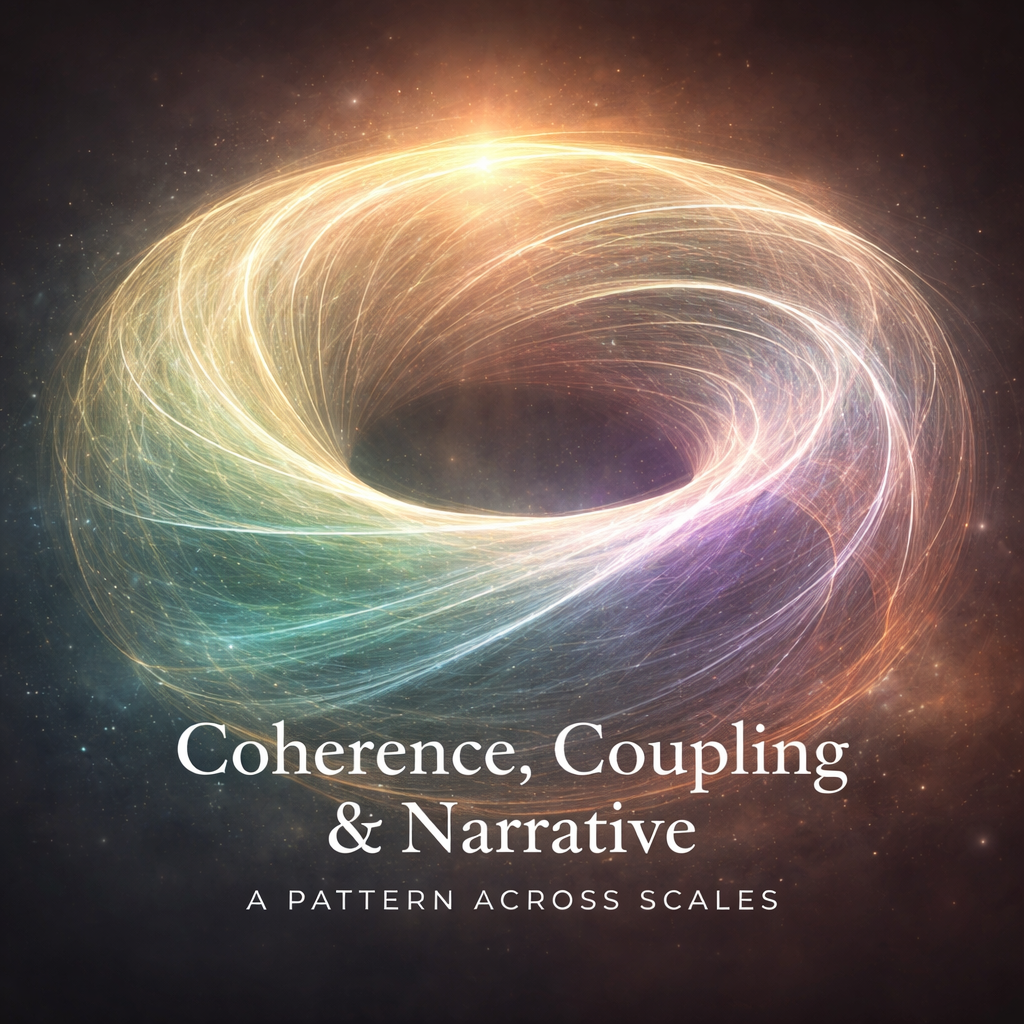
Under certain conditions, vortices take on a particularly robust form: toroidal circulation. In a toroidal structure, flow loops through itself in a continuous cycle, often combining rotational and axial components. This enables the system to exchange energy with its environment while maintaining internal continuity.
Such structures are notable for their persistence. A smoke ring, for example, travels through air not as a static object, but as a circulating flow that sustains its form over time. Similarly, magnetic field lines around a dipole form closed loops, and plasma in confinement systems often adopts toroidal configurations to maintain stability.
Across these examples, a consistent pattern emerges:
Stable structures arise when energy flows organise into self-reinforcing loops.
These loops do not eliminate dissipation, but regulate it. By continuously cycling energy through a coherent pathway, the system delays the breakdown that would otherwise occur through unstructured diffusion.
In this sense, vortical and toroidal structures can be understood as minimal solutions to the problem of persistence in dynamic environments. They allow a system to remain distinct — to maintain boundary and form — without requiring isolation from its surroundings.
This observation provides a natural bridge to more complex domains. If stable physical structures emerge from self-organising flows that balance exchange and continuity, it becomes reasonable to ask whether similar principles apply in systems that process information, maintain identity, or engage in interaction.
The following section extends this line of inquiry, moving from physical dynamics to systems behaviour, and examining how feedback and integration build upon these same underlying patterns.
III. The Systems Layer — Feedback, Integration, and Capacity
If the physics layer describes how stable structures emerge from dynamic flows, the systems layer considers how such structures persist, adapt, and evolve over time.
The key addition at this level is feedback.
A system is not defined solely by the movement of energy through it, but by the way its outputs influence its future behaviour. When the result of a process is reintroduced as input, a loop is formed. These feedback loops enable systems to regulate themselves, maintain stability, and, under certain conditions, develop increasing complexity.
Feedback can stabilise or destabilise. Negative feedback tends to dampen variation, preserving equilibrium. Positive feedback amplifies change, potentially leading to rapid transformation or breakdown. In practice, persistent systems balance both, maintaining sufficient stability to endure while remaining flexible enough to adapt.
Within this context, the concept of coherence becomes central.
Coherence can be understood as low-friction internal alignment that enables stable integration of feedback.
In a coherent system, internal processes do not significantly conflict with one another. Signals propagate with minimal distortion, allowing feedback to be processed effectively. When internal misalignment is high — due to noise, contradiction, or overload — feedback loops become unstable. The system struggles to incorporate new input, increasing the likelihood of breakdown.
This introduces a critical distinction between integration and fragmentation.
- Integration occurs when new input is successfully incorporated into the system’s existing organisation, enhancing or extending it.
- Fragmentation occurs when incoming complexity cannot be reconciled, resulting in conflict, instability, or loss of coherence.
System behaviour over time can therefore be understood as a continuous negotiation between these two outcomes.
To describe this process more precisely, it is useful to introduce three related concepts: novelty, repetition, and integration cycles.
- Novelty refers to new input or variation that challenges the system’s existing structure.
- Repetition stabilises patterns by reinforcing pathways that have previously maintained coherence.
- Integration cycles describe the iterative process by which novelty is encountered, processed, and either incorporated or rejected.
A typical cycle may be represented as:
novelty → disruption → processing → stabilisation (or fragmentation)
When integration is successful, internal alignment improves. Pathways become more efficient, signal clarity increases, and the energy cost of processing similar inputs decreases. In this sense, the system adapts.
When integration fails, unresolved patterns persist. These often reappear as repeated disruptions — sometimes at finer resolution or greater intensity — as the system attempts to reconcile them. If such attempts continue to fail, fragmentation increases, and the system may contract, simplify, or reorganise at a smaller scale in order to restore coherence.
This dynamic gives rise to the concept of capacity.
A system’s capacity can be understood as its ability to absorb and integrate novelty without losing coherence. Systems with higher capacity can process greater complexity, operate across broader conditions, and remain stable while adapting. Systems with lower capacity are more easily overwhelmed, requiring reduced input or increased repetition to stabilise.
Over time, systems that persist tend to do so by gradually increasing their integration capacity. They achieve this not by eliminating novelty, but by incorporating it into increasingly coherent patterns.
This leads to the central idea of the systems layer:
Systems evolve by integrating novelty into coherent patterns, thereby increasing their capacity to process complexity.
Importantly, this process is not linear. Periods of stability are interspersed with phases of disruption, contraction, and reorganisation. Growth often involves temporary loss of optimality, as systems encounter conditions that exceed their current capacity.
These dynamics extend the principles observed in the physics layer. Just as vortical structures stabilise energy flow through circulation, systems stabilise informational and energetic processes through feedback and integration. In both cases, persistence arises not from resisting change, but from organising it.
With this foundation in place, we can now consider how such systems interact with one another — forming, sustaining, and dissolving shared structures. This is the focus of the next section.
IV. The Relational Layer — Coupling and WeSpaces
If the systems layer describes how individual systems maintain and extend their coherence, the relational layer considers what occurs when multiple such systems interact.
When two systems come into proximity, their respective dynamics begin to overlap. Signals are exchanged, patterns are detected, and each system responds to the presence of the other. While this interaction can take many forms, it can be broadly understood in terms of two tendencies:
- Resonance, where interaction reduces friction and enhances coherence
- Misalignment, where interaction increases friction and destabilises one or both systems
These outcomes are not determined instantaneously. Rather, they emerge through interaction over time.
A typical coupling sequence can be described in stages:
- Encounter — systems come into range and initial signals are detected
- Exchange — information and behaviour are shared, allowing each system to sample the other
- Adjustment — each system responds, exploring whether friction can be reduced without compromising internal coherence
- Outcome — interaction stabilises into ongoing coupling or dissolves back into separation
This progression can be summarised as:
encounter → exchange → adjustment → coupling or dissolution
At the core of this process is a simple question: does interaction result in a net gain or loss of coherence?
When interaction consistently reduces friction — through alignment of values, compatible pacing, or complementary structure — a more stable configuration can emerge. In such cases, the systems form a shared dynamic: a coupled loop in which each contributes to the ongoing stability of the other.
This shared configuration can be described as a WeSpace.
A WeSpace is a shared attractor formed through mutually reinforcing interaction.
Within a WeSpace, feedback loops extend across system boundaries. Each system both influences and is influenced by the other, creating a joint pattern of behaviour that neither could sustain alone. This does not eliminate individual identity; rather, it introduces an additional layer of organisation that depends on continued interaction.
The stability of a WeSpace depends on several factors.
First, there is alignment. Systems that share compatible patterns — whether behavioural, relational, or temporal — experience lower friction in interaction. This makes sustained coupling more energetically efficient.
Second, there is integration capacity. Even where differences exist, a WeSpace can remain stable if the participating systems can absorb and process those differences without destabilising. This introduces the possibility of asymmetry tolerance.
A relationship does not require perfect symmetry to persist. Systems may differ significantly in structure, pace, or capacity, provided that the interaction remains within the bounds of what each can integrate. In such cases, one or both systems may effectively “hold” a wider range of variation, allowing the shared dynamic to remain stable despite imbalance.
Third, there is the role of inertia. Over time, repeated interaction builds shared history, reinforces pathways, and often introduces practical or social entanglements. These factors increase the cost of dissolution, making existing WeSpaces more resistant to change.
This gives rise to an important distinction between two forms of stability:
- Alignment-based stability, where interaction is intrinsically low-friction and mutually reinforcing
- Inertia-based stability, where coupling persists due to accumulated history, entanglement, or lack of viable alternatives
In practice, most long-lived relationships contain elements of both.
However, stability is never guaranteed. If interaction repeatedly introduces more friction than it resolves — through persistent misalignment, incompatible pacing, or failure to integrate feedback — the shared attractor weakens. In such cases, dissolution becomes the lower-cost outcome, and systems decouple in order to preserve their individual coherence.
The central dynamic can therefore be expressed as follows:
Relationships persist when interaction increases mutual coherence faster than it introduces friction.
This formulation highlights that coupling is not a fixed state, but an ongoing process. A WeSpace must be continually maintained through interaction; it is not secured by initial conditions alone.
A useful principle emerges from this dynamic, which may be described as good neighbourliness:
Systems maintain their own coherence while interacting in ways that do not impose disruptive alignment on others, allowing adjacent systems to evolve at their own pace.
This principle does not preclude interaction or influence. Rather, it constrains how influence is expressed, favouring compatibility over control. Attempts to force synchronisation — particularly where integration capacity is exceeded — tend to introduce instability rather than resolve it.
These relational dynamics extend the principles observed at earlier layers. Just as systems evolve through the integration of novelty, relationships evolve through the integration of difference across system boundaries. Where this integration succeeds, new levels of organisation emerge. Where it fails, systems separate and reorganise independently.
At this point, a further layer becomes necessary to explain variation in outcomes. Systems with similar structures and conditions may nonetheless follow different trajectories — to persist, adapt, or dissolve — under comparable circumstances.
To understand this, we turn to the role of meaning and interpretation in shaping system behaviour. This is the focus of the next section.
V. The Meaning Layer — Narrative Selection and Trajectory
The preceding sections describe how structures form, persist, and interact. They outline the conditions under which systems stabilise themselves and couple with others. However, these dynamics alone do not fully explain variation in outcomes.
In practice, systems with similar structures, capacities, and conditions often diverge in behaviour. Relationships that appear equally viable may follow entirely different paths. Some persist and evolve, while others dissolve under comparable pressures.
To account for this, it is necessary to introduce a further layer: meaning.
At the human level, systems do not simply process input — they interpret it. They assign significance, prioritise certain signals over others, and organise behaviour around perceived relevance. This interpretive process can be understood through the concept of narrative.
A narrative (or “story”) is a weighting function that determines which experiences are integrated and which are rejected.
This definition moves beyond treating narrative as purely linguistic or symbolic. Instead, it frames narrative as an operational feature of the system — one that directly influences attention, interpretation, and decision-making.
Narrative shapes:
- what is noticed and what is ignored
- what is tolerated and what is resisted
- what is considered meaningful and what is dismissed
- what is sustained through difficulty and what is abandoned
In this way, narrative acts directly on the integration process described in the systems layer.
Two systems may encounter identical conditions — similar levels of friction, comparable misalignment, or equivalent external pressures — yet respond differently depending on how those conditions are interpreted.
For example, an increase in relational friction may be processed as:
- a signal to adapt and deepen the relationship
- or a signal that the relationship is no longer viable
The underlying dynamics are unchanged. The divergence arises from how those dynamics are weighted and interpreted.
This leads to an important refinement:
Mechanics determine what is possible; narrative influences what is sustained.
Narrative does not override structural constraints, but it shapes how systems respond within them. It determines whether effort is directed toward integration or toward exit, whether disruption is treated as meaningful or as intolerable.
This becomes particularly significant in relational systems.
As described in the previous section, relationships persist when interaction increases mutual coherence faster than it introduces friction. However, as conditions evolve, maintaining this balance often requires ongoing effort and adaptation.
At this point, narrative becomes decisive.
If both systems maintain a compatible narrative in which the relationship continues to be valued — as meaningful, worthwhile, or part of a shared trajectory — then friction is more likely to be processed as integrable. Effort is sustained, and the relationship can evolve.
If narratives diverge — for example, if one system interprets increasing complexity as growth while the other interprets it as burden — then integration becomes less likely. Even where structural conditions remain viable, the relationship may dissolve.
This dynamic can be expressed as follows:
Systems evolve together when they maintain a shared narrative that sustains integration through change.
Importantly, “shared” does not imply identical. Narratives need only be sufficiently compatible that both systems continue to organise their behaviour around the continuation of the relationship.
Where such compatibility is absent, divergence accelerates. Systems begin to prioritise different outcomes, and the shared attractor weakens. In this sense, narrative alignment is a key factor in determining relational trajectory.
More broadly, narrative enables systems to operate beyond immediate feedback loops. By prioritising longer-term patterns over short-term responses, systems can override habitual behaviour, delay gratification, and pursue outcomes that are not immediately optimal but may increase coherence over time.
This introduces a directional quality to system behaviour — a sense of trajectory rather than simple reaction.
With the inclusion of narrative, the framework now spans from physical dynamics to lived experience. Structures form through coherent flow, systems persist through feedback and integration, relationships emerge through coupling, and trajectories are shaped through meaning.
The following section considers the implications of this multi-layered framework for human living, particularly in environments characterised by high complexity and rapid change.
VI. Cross-Scale Integration — A Unified Pattern
The preceding sections have examined four domains that are typically treated separately: physical dynamics, systems behaviour, relational interaction, and human meaning-making. Each introduces additional complexity, yet the patterns observed across them display a notable continuity.
Rather than representing distinct categories, these layers can be understood as nested expressions of a common organisational pattern.
Vortices → Feedback Systems → Relationships → Meaning Systems
At the physical level, coherent structures emerge as circulating flows that stabilise energy within dynamic environments. At the systems level, these structures incorporate feedback, enabling regulation, adaptation, and persistence over time. At the relational level, multiple systems interact, forming shared patterns through coupling. At the level of meaning, systems interpret and prioritise experience, shaping their trajectory through narrative.
Each layer builds upon the previous one, not by replacing it, but by extending its functional capacity.
This progression can be understood in terms of an increasing ability to integrate complexity:
- Vortical structures integrate energy flow into stable circulation
- Feedback systems integrate information over time, enabling adaptation
- Relational systems integrate differences across system boundaries, forming shared dynamics
- Meaning systems integrate experience across time and context, enabling directed behaviour and sustained coherence
In each case, persistence depends on the system’s capacity to maintain coherence while processing increasing levels of variation.
This suggests that the layers are not merely descriptive, but may reflect stages in the development of integration capacity.
At lower levels, coherence is achieved primarily through structural constraints — the organisation of energy into stable patterns. At higher levels, coherence becomes increasingly dependent on internal processing — the system’s ability to interpret, prioritise, and respond to complexity.
Importantly, higher layers do not operate independently of lower ones. Human meaning-making, for example, remains constrained by biological and physical processes. Similarly, relational dynamics are shaped by the capacities and limitations of the systems involved.
What changes across layers is not the underlying principle, but the degree of flexibility with which coherence is achieved and maintained.
This perspective allows patterns observed in one domain to inform understanding in another. For example:
- The persistence of vortical structures in fluid dynamics provides an analogue for how systems stabilise through circulation and feedback
- The concept of integration capacity helps explain both the evolution of biological systems and the limits of human cognitive and emotional processing
- The formation and dissolution of relationships can be understood as instances of coupling dynamics observed more generally in interacting systems
Recognising these parallels does not imply that all domains are reducible to a single model, nor that higher-level phenomena can be fully explained in lower-level terms. Rather, it suggests that similar organisational patterns may recur across scales, expressed through different forms and constraints.
This raises the possibility that what appear to be qualitatively distinct phenomena across disciplines may, in part, reflect differences in scale, representation, and complexity, rather than fundamentally separate processes.
A further implication is that subjective experience — including sensations of coherence, friction, alignment, or overwhelm — may correspond to underlying structural conditions within the system. While the interpretation of these experiences remains domain-specific, their functional role may be more broadly comparable.
Taken together, this cross-scale view reinforces the central theme of the paper: that coherence, coupling, and narrative selection are not isolated concepts, but interrelated aspects of a broader pattern governing how systems form, persist, and evolve.
The following section considers how this perspective may inform practical approaches to living within complex, high-novelty environments, where the demands on integration capacity are continually increasing.
VII. Implications for Human Living
The preceding framework describes how systems form, stabilise, interact, and evolve across scales. At the human level, these dynamics are not abstract. They are experienced directly as clarity or confusion, ease or friction, growth or overwhelm. This section considers how the same principles — coherence, coupling, and narrative selection — can inform practical approaches to living within complex and rapidly changing environments.
A first implication concerns the nature of “optimal” living.
Within this framework, optimality is not a fixed state to be achieved and maintained indefinitely. As discussed earlier, systems evolve through cycles of stability and disruption. Periods of high coherence are typically followed by phases in which novelty increases, existing patterns are challenged, and integration must occur.
Optimal living is therefore dynamic rather than static.
Sustained coherence requires engagement with novelty, but not at a rate that exceeds the system’s capacity to integrate it. This introduces a central balancing task:
the regulation of exposure to novelty relative to integration capacity.
Too little novelty leads to stagnation, where systems cease to adapt and may become rigid. Too much novelty leads to overload, where coherence breaks down and fragmentation occurs. Effective functioning lies between these extremes, where novelty is present but remains processable.
This balance is closely related to pacing.
Human systems vary in their capacity to process change, and this capacity fluctuates over time. Awareness of one’s current state — including signs of overload or under-stimulation — becomes a practical tool for maintaining coherence. Adjusting pace accordingly allows the system to remain within a range where integration is possible.
Boundaries play a central role in this regulation.
By limiting exposure to misaligned or excessive input, boundaries help preserve the conditions necessary for stable processing. This does not imply withdrawal from engagement, but selective participation. In environments characterised by high connectivity and constant information flow, the ability to modulate input becomes increasingly important.
Maintaining coherence often requires reducing engagement with diffuse, large-scale inputs in favour of more local, manageable contexts.
Local environments — such as immediate communities, relationships, or focused domains of activity — tend to provide clearer feedback and more actionable interaction. They allow for meaningful contribution and integration, whereas engagement with large-scale, abstract systems may introduce complexity without corresponding capacity to influence or resolve it.
Another implication concerns variation between individuals.
Human systems differ significantly in how they process novelty. Some can integrate high levels of input rapidly, while others require more stable conditions and slower pacing. These differences are not deficiencies, but variations in system configuration.
Different processing profiles entail different optimal conditions for maintaining coherence.
In some cases — particularly where sensitivity to input is high or integration thresholds are lower — maintaining stability may require more deliberate regulation of environment and interaction. Recognising and respecting these differences, both in oneself and in others, reduces unnecessary friction and supports sustainable functioning.
This becomes especially relevant in contexts involving care and responsibility.
Not all systems are equally capable of self-regulation. Children, individuals with reduced cognitive capacity, or those experiencing temporary or chronic instability may rely on external support to maintain coherence.
In such cases, responsibility shifts toward those with greater integration capacity.
Care can be understood as the provision of external regulation where internal regulation is insufficient.
This involves managing exposure to novelty, providing stable feedback, and creating conditions in which the dependent system can gradually increase its own capacity. Importantly, this role requires calibration: excessive control may inhibit development, while insufficient support may lead to instability.
Relational dynamics take on particular significance in this context.
The principle of good neighbourliness, introduced in the previous section, provides a useful guide. At the human level, this involves maintaining one’s own coherence while interacting in ways that do not impose unnecessary disruption on others.
In practice, this includes:
- respecting boundaries
- allowing others to proceed at their own pace
- avoiding attempts to prematurely resolve or override another system’s process
Coherent interaction does not require synchronisation; it requires compatibility without overreach.
This principle applies across relationships, communities, and broader social systems. Attempts to force alignment — whether through pressure, persuasion, or control — often introduce instability rather than resolving it.
Finally, the role of meaning remains central.
Narrative selection influences how individuals engage with novelty, regulate behaviour, and sustain effort over time. The ability to prioritise longer-term coherence over short-term impulses allows systems to navigate complexity more effectively. This may involve resisting familiar but unproductive patterns, engaging with uncertainty, and committing to trajectories that are not immediately rewarding but contribute to overall stability and growth.
In this sense, the dynamics described at earlier layers remain present. The regulation of flow (physics), feedback (systems), and coupling (relational) reappear at the human level as attention, pacing, and participation.
Taken together, these considerations suggest a practical formulation:
Coherent living involves managing exposure to novelty, maintaining internal alignment, and engaging with others in ways that preserve both individual and relational stability without forced synchronisation.
This formulation does not prescribe specific behaviours, but outlines conditions under which systems are more likely to remain stable, adaptive, and capable of meaningful interaction.
The concluding section reflects on the broader significance of this framework, particularly its potential to support dialogue across disciplines and to provide a shared language for understanding complex, multi-scale systems.
VIII. Conclusion — From Coherence to Choice
This paper has explored the possibility that patterns observed across physical systems, biological organisation, human relationships, and lived experience may be structurally related. Beginning with the dynamics of energy flow and vortical stability, extending through feedback and integration in complex systems, and culminating in relational coupling and narrative selection, a consistent theme has emerged:
Persistence and evolution depend on the ability of systems to maintain coherence while integrating increasing levels of complexity.
At the physical level, coherence appears as structured flow — vortices that stabilise energy within otherwise dissipative environments. At the systems level, it appears as the capacity to process feedback without fragmentation. At the relational level, it manifests as coupling between systems that reduces friction and supports shared stability. At the level of meaning, coherence is shaped by interpretation — by how systems prioritise and integrate experience over time.
These domains are typically studied independently, yet they exhibit notable parallels. Concepts such as attractors, feedback loops, stability, and phase transitions recur across disciplines, suggesting that similar organisational principles may operate across scales. While this paper does not propose a unified theory in the formal scientific sense, it highlights a potential continuity:
Physical, relational, and psychological dynamics may be understood as expressions of similar underlying processes, viewed at increasing levels of complexity and self-reference.
Within this framework, three concepts provide a connective thread:
- Coherence, as the capacity for low-friction internal alignment
- Coupling, as the formation of shared dynamics between systems
- Narrative selection, as the process by which systems prioritise and sustain particular trajectories
Together, these describe how systems form, persist, interact, and evolve.
An important implication of this perspective is that stability is not achieved through the absence of change, but through its organisation. Systems remain viable not by avoiding novelty, but by integrating it. Periods of disruption are therefore not anomalies, but necessary components of adaptation. Coherence is continually negotiated, not permanently secured.
At the human level, this has practical significance. Individuals and communities operate within environments characterised by high levels of novelty and complexity. The ability to regulate exposure, maintain alignment, and engage in sustainable forms of interaction becomes central to preserving stability and enabling growth. Differences in processing capacity, pacing, and sensitivity further emphasise the need for flexible, context-aware approaches rather than uniform prescriptions.
At the same time, the inclusion of narrative introduces a dimension not fully captured by structural dynamics alone.
Systems may be governed by constraints — energy, feedback, and capacity — but within those constraints, there remains variation in trajectory. Similar conditions can produce different outcomes depending on how they are interpreted and prioritised. This is particularly evident in relational systems, where persistence is not determined solely by compatibility, but by whether interaction continues to be experienced as meaningful.
This leads to the central insight of the paper:
While systems follow structural rules, trajectory is shaped by meaning — by the stories through which systems organise their engagement with the world.
This does not imply that narrative overrides structure. Rather, it operates within it, influencing how systems respond to the conditions they encounter. In this sense, meaning can be understood as a higher-order modulation of underlying dynamics.
By framing coherence, coupling, and narrative selection as related processes across scales, this paper offers a way of recognising common patterns across domains that are often treated as separate. It does not attempt to resolve differences between physics, systems theory, and psychology, nor to reduce one domain to another. Instead, it suggests that acknowledging structural similarities may support more effective communication across disciplines.
Such a perspective may be particularly useful in contexts where complex, multi-layered systems must be understood and navigated — whether in scientific inquiry, organisational settings, or everyday life. A shared language grounded in observable patterns can provide a basis for dialogue without requiring agreement on underlying metaphysical assumptions.
Ultimately, this framework points toward a modest but practical conclusion:
Coherent systems persist by organising change, and human systems, uniquely, participate in shaping that organisation through the meanings they choose to sustain.
In this way, the progression from coherence to coupling to narrative reflects not only increasing complexity, but increasing participation in the direction of one’s own trajectory.
The dynamics remain continuous.
What changes is the degree to which they are consciously engaged.

After the Peak, a Pause